Canada Opens Its Doors to Chinese-Built EVs Under New Tariff Quota
The Canadian automotive landscape is undergoing a significant transformation. Thanks to a newly implemented trade arrangement, electric vehicles manufactured in China are beginning to arrive on Canadian shores under a dramatically reduced tariff structure. While the policy shift opens up a competitive pathway for global automakers, early import figures indicate that one major American brand is currently dominating this newly paved road.
Historically, EVs imported from China faced an incredibly steep, almost prohibitive 100 percent additional tariff. Under the revised trade system, however, qualifying electric vehicles face a remarkably low tariff of just 6.1 percent. This adjustment offers a massive financial incentive for brands utilizing Chinese manufacturing hubs to supply the North American market.
Understanding the Quota Allocations
While the tariff reduction is substantial, the Canadian government has put a strict volume-based cap in place to regulate the influx of these vehicles. The system is designed around a maximum annual quota, structured as follows:
- Total Annual Capacity: Up to 49,000 Chinese-built electric vehicles can enter Canada at the reduced 6.1 percent tariff rate in the first year.
- The First Phase: The initial allocation allows for 24,500 vehicles to be imported between March and August.
- The Second Phase: The remaining 24,500 units are allocated for the subsequent six-month period, running from September through February.
May Import Data: Tesla Claims the Lion's Share
Latest statistics from Global Affairs Canada show that during the month of May, a total of 2,910 eligible vehicles were brought into the country under the reduced tariff. This represents roughly 12 percent of the available quota for the initial six-month period.
Although federal authorities have not officially disclosed the exact brand breakdown of these imports, industry analysts point to Tesla as the primary beneficiary. The Texas-based EV giant has been actively exporting its refreshed Model 3 sedans from its state-of-the-art Gigafactory in Shanghai directly to Canadian consumers. By leveraging its established high-volume production lines in China, Tesla has been able to quickly satisfy Canadian demand while dodging the previously punitive tariff rates.
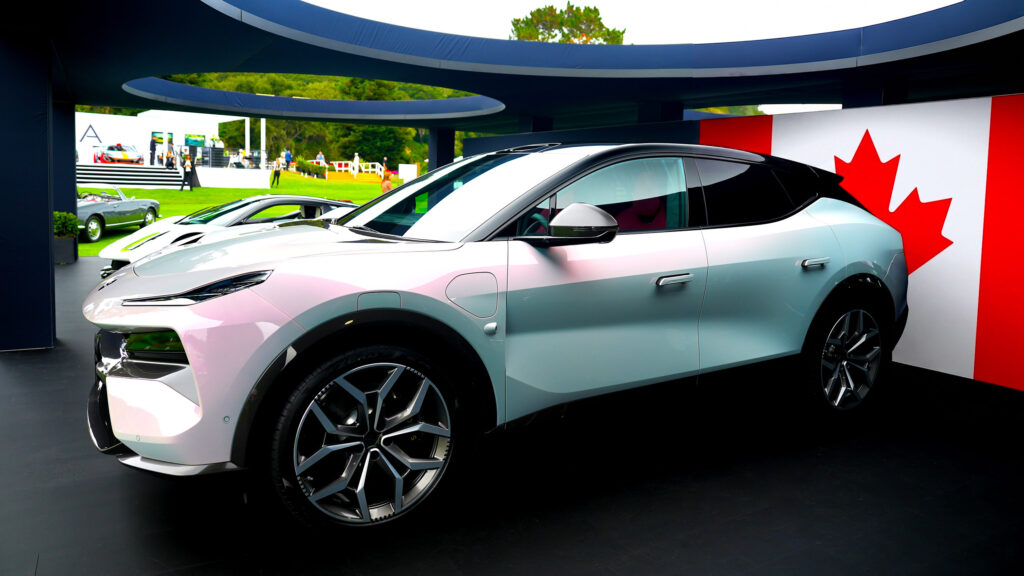
In contrast, domestic Chinese brands are still in the preliminary stages of their Canadian market entries. Of the nearly 3,000 vehicles imported in May, only 18 units were confirmed to be non-Tesla models. All 18 of these vehicles were units of the ultra-premium, all-electric Lotus Eletre hyper-SUV, which is produced by the Geely-owned luxury marque in Wuhan, China.
A Wave of New Competitors is Coming
While Tesla currently enjoys an uncontested lead in utilizing the quota, a diverse group of international and Chinese automakers is preparing to challenge its dominance. Geely, which owns both Volvo and Polestar, is expected to eventually transition some of its Canadian-bound EV shipments to benefit from the 6.1 percent tariff rate, as both brands build highly regarded electric vehicles in China.
Furthermore, several prominent Chinese automakers are currently laying the groundwork for official Canadian launches:
- Chery: The manufacturing giant plans to introduce its adventure-oriented Jaecoo brand to Canadian dealerships in the near future.
- BYD: The world's largest plug-in vehicle manufacturer is reportedly planning a massive Canadian expansion, aiming to open up to 20 physical retail locations this year alone. Rumors also suggest the brand is evaluating options for a localized assembly plant.
- Zeekr: Geely's premium electric brand is already recruiting senior-level executives in Toronto as it prepares its retail and service network.
As these new players secure their import pipelines, the remaining quota slots are expected to fill up rapidly, setting the stage for an intense EV market battle across Canada.
Image Credit & Source: Original Article